B2B Website Storytelling: Turn Features Into Customer Value
Why B2B Websites Need Better Storytelling
Many B2B websites do a good job explaining what a company makes or sells. They list products, capabilities, certifications, and technical specifications.
But they often miss something important: explaining why those details matter to the customer.
A manufacturing website might describe its equipment, materials, and production capabilities without clearly connecting them to the problems buyers need to solve.
This is where B2B website storytelling can help.
B2B storytelling is not about adding dramatic language. It is about making complex information easier to understand and connecting technical capabilities with real customer needs.
As part of a broader B2B content strategy, effective storytelling helps companies explain what they offer, demonstrate their expertise, and guide potential buyers toward relevant solutions.
Start With the Customer’s Problem
Technical buyers usually visit a website with a specific question.
They might need a component that meets certain tolerances, a supplier that can manage production requirements, or a solution that reduces maintenance.
If the website opens with a long company history and generic claims, visitors may struggle to find the answer.
A better approach is to connect capabilities with customer needs.
For example:
Feature-focused message: “We offer advanced CNC machining capabilities.”
Customer-focused message: “We manufacture precision components to your specifications, with support from prototype development through production.”
The second example explains what the capability helps customers accomplish.
This customer-focused approach is central to B2B brand storytelling. Instead of simply describing the business, it helps buyers understand how the company’s expertise relates to their challenges.
Use a Clear Problem, Solution, Proof Structure
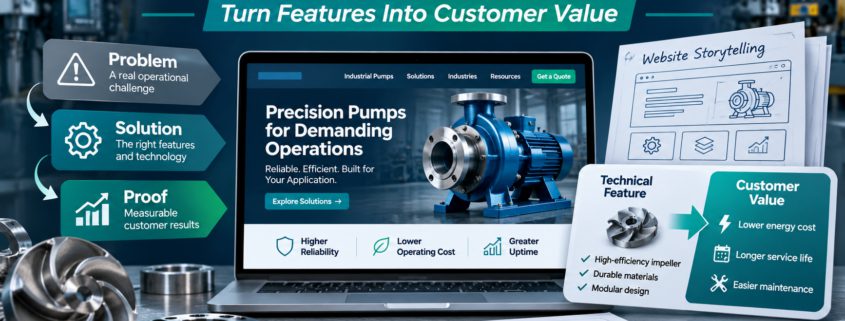
A practical B2B story has three parts:
- Problem: What challenge is the customer facing?
- Solution: How does the company’s product or service address it?
- Proof: What evidence supports the claim?
This structure works well on industry pages, product pages, service pages, and case studies.
The proof might include technical specifications, testing results, certifications, or an approved customer example.
For instance, a manufacturer supplying components for industrial equipment might address a buyer’s need for dependable performance in demanding operating conditions.
The website can explain the application, identify the relevant product capabilities, and provide specifications or testing documentation to support its claims.
This makes manufacturing website content more useful to engineers, procurement teams, and other decision-makers evaluating potential suppliers.
What Better B2B Website Content Looks Like
| Common Website Content | More Useful Approach |
| Long list of company capabilities | Explain which customer problems those capabilities solve |
| General quality claims | Show certifications, inspection methods, or documented results |
| Product features without context | Connect features to relevant applications |
| Generic industry landing pages | Address specific industry requirements |
| Company-focused case studies | Explain the customer’s challenge and outcome |
How Website Design Supports B2B Storytelling
Good storytelling also depends on how information is organized and presented.
Effective industrial website design should help buyers move naturally from understanding a company’s capabilities to evaluating whether those capabilities meet their needs.
A few important elements include:
- Clear page layout: Highlight the customer’s challenge and the relevant solution before introducing extensive technical details.
- Logical navigation: Help visitors quickly find products, applications, industries served, and supporting resources.
- Useful visuals: Include product photography, diagrams, process illustrations, and relevant application images that clarify complex information.
- Content hierarchy: Use descriptive headings, short sections, and supporting details to make pages easier to scan.
- Relevant calls to action: Give buyers a clear way to request specifications, discuss applications, or contact a technical expert.
For example, an industrial supplier’s product page might begin with the product’s application, followed by key benefits, technical specifications, supporting documentation, and a request-for-quote option.
This structure helps buyers understand the value of an offering while still providing the technical information they need.
Technical Information Still Matters
Storytelling should never replace technical detail.
Engineers and procurement teams still need specifications, drawings, material information, and other data to evaluate a supplier.
The goal is to help buyers understand the value first, then make supporting details easy to find.
For example, an industrial product page might include:
- A clear description of the product and its application.
- The problem it is designed to solve.
- Key specifications and available options.
- Supporting documents and certifications.
- A relevant customer example.
- An option to request technical information or a quote.
For a manufacturer serving food processing facilities, this might mean explaining how a particular component addresses cleaning requirements or operating conditions, followed by material specifications and applicable certifications.
This gives different buyers a way to find the information they need without sacrificing technical accuracy.
Use Case Studies to Show the Work
Case studies give B2B companies an opportunity to make their expertise more concrete.
A useful case study explains what the customer needed, what made the project challenging, how the company responded, and what happened.
Whenever possible, include approved numbers, process details, or measurable results.
Avoid publishing unsupported claims about cost savings, efficiency, or performance.
Manufacturing Storytelling in Action
Stevens & Tate’s work with Graymills, a manufacturer of industrial pumps, parts washers, and inking systems, demonstrates how customer-focused messaging can strengthen an industrial brand.
Rather than emphasizing products alone, the marketing approach highlighted Graymills’ ability to provide innovative solutions to real-world customer challenges.
Stevens & Tate helped define the company’s competitive advantages, brand positioning, and messaging, which were then incorporated into its website and other marketing materials.
This example shows how manufacturers can connect technical capabilities with a clearer value proposition across digital and traditional communications.
Make It Easy for Buyers to Take the Next Step
Once visitors understand the offering, they should know what to do next.
Depending on the business, that might mean:
- Requesting a quote.
- Downloading a product specification.
- Speaking with an engineer.
- Reviewing related applications.
- Contacting the sales team.
The call to action should fit the information on the page.
A product page might encourage buyers to request technical specifications, while an industry page could direct visitors to a relevant case study or application example.
Connecting these steps through clear navigation and relevant content helps B2B websites support buyers throughout their evaluation process.
Better B2B Website Storytelling Makes Complex Offerings Clearer
B2B buyers do not need exaggerated marketing messages.
They need a clear explanation of what a company offers, how it solves relevant problems, and why its claims are credible.
Good storytelling connects those details without getting in the way of technical information.
However, effective B2B website storytelling is more than rewriting product descriptions. It should be part of a broader content strategy that connects customer needs, messaging, website design, and conversion opportunities.
When these elements work together, manufacturers can communicate their value more clearly and help potential customers evaluate the right solutions.
Turn Technical Capabilities Into Customer-Focused Content
Does your B2B website explain the value behind your capabilities?
Stevens & Tate helps manufacturers and B2B companies connect brand messaging, content strategy, and digital marketing to communicate complex products and services more effectively.
Explore our Digital Marketing Services to learn how website development, content marketing, and digital strategy can support your business goals.
Let’s make sure your customers understand the value you deliver.
Schedule a Marketing Consultation to discuss how Stevens & Tate can help strengthen your B2B website storytelling and marketing strategy.
Frequently Asked Questions
B2B storytelling explains products and services through customer problems, practical solutions, and supporting evidence. It helps businesses communicate technical information in a way that buyers can understand and evaluate.
Manufacturing websites often contain complex information about products, processes, and capabilities. Storytelling connects those technical details to real customer applications, making it easier for buyers to understand the value offered.
Start by identifying common customer challenges. Explain how products or services address those needs, support claims with technical details, and use case studies to demonstrate real applications and results. Clear website navigation and content organization also help buyers find the information they need.
Storytelling can support lead generation by making offerings easier to understand and helping potential buyers evaluate their fit. Clear messaging, credible examples, and relevant calls to action can encourage qualified visitors to contact the company.