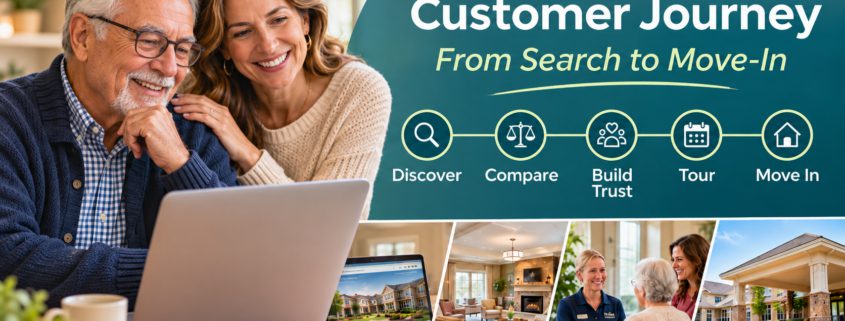
The Senior Living Customer Journey: From Search to Move-In
The New Senior Living Resident Journey Starts Online
A senior living inquiry often begins long before someone contacts a community.
A family may start by searching for assisted living options, reading reviews, comparing services, or looking at community websites.
By the time they schedule a tour, they may already have several opinions about the communities they are considering.
The senior living customer journey includes every step families take, from their initial online research to comparing communities, scheduling visits, and making a move-in decision.
For senior living marketers, the challenge is to provide the right information throughout that process. An effective senior living digital marketing strategy helps communities reach families at different stages, answer their questions, and make it easier to take the next step.
Understanding the Senior Living Customer Journey
The resident journey rarely follows one straight path.
Some families research options over several months. Others need answers quickly after a change in health or living circumstances.
The decision may involve a prospective resident, adult children, caregivers, and other family members.
This senior living buyer journey requires a marketing approach that supports different information needs, timelines, and decision-makers.
A strong marketing strategy should help families find relevant information, compare their options, and connect with admissions teams when they are ready.
Stage 1: Online Discovery
The journey often starts with a search for available communities or information about care options.
Families may look for:
- Assisted living communities near a specific location
- Differences between independent living and assisted living
- Senior living costs
- Available care and support services
- Community reviews and ratings
Local search visibility matters here.
Community websites should have accurate location information, clearly described services, and consistent business details.
Local SEO and search engine optimization can help communities appear in relevant searches. This includes optimizing location pages, maintaining accurate Google Business Profiles, and creating helpful content around common family questions.
For example, a family searching for assisted living in a specific city should be able to find relevant community information without navigating multiple unrelated pages.
A strong online presence makes it easier for families to discover a community at the beginning of their research.
Stage 2: Comparing Communities
Once families identify possible options, they begin evaluating them more closely.
They may compare websites, online reviews, photos, services, amenities, and general pricing information.
A community website should answer common questions without requiring visitors to call for every detail.
Important information includes care options, accommodations, dining, activities, accessibility, and how to arrange a visit.
Content marketing and online reviews play an important role during this stage.
Helpful service pages, FAQs, and educational articles can explain what a community offers. Authentic reviews and accurate responses to feedback can also help families understand other people’s experiences.
For communities developing an assisted living marketing strategy, this stage is an opportunity to address common concerns and clearly explain what makes their services different.
The goal is to help families compare their options using useful, trustworthy information.
Stage 3: Building Confidence
Before contacting a community, families often want reassurance that they are making a reasonable choice.
Useful content includes:
- Video tours showing actual facilities
- Resident and family stories
- Staff introductions
- Answers to common care questions
- Information about what happens during a visit
Trust comes from providing useful, accurate information rather than making broad promises.
Digital marketing can support this stage by making videos, testimonials, and educational resources easy to access.
For example, a virtual tour may help an out-of-town family understand the community layout, while a staff introduction video can provide insight into the people who support residents.
These resources should reflect actual community experiences, with appropriate consent and respect for resident privacy.
Stage 4: Scheduling a Tour
A website should make it easy to request a tour or ask a question.
Long forms and unclear contact options can create unnecessary barriers.
Consider offering phone, email, and online inquiry options, depending on how the community handles admissions.
Make sure someone can follow up promptly and provide information relevant to the family’s situation.
This is an important stage for senior living lead generation.
Clear calls to action, mobile-friendly forms, and accessible contact information help interested families take the next step.
Email marketing and customer relationship management (CRM) systems can also help admissions teams organize inquiries, track communication, and provide timely responses.
For example, after receiving a tour request, a community might send a confirmation email with directions, parking details, and information about what to expect during the visit.
The goal is to make the inquiry process straightforward and helpful.
Stage 5: From Tour to Move-In
Marketing does not stop when someone schedules a visit.
Families may still be comparing options, discussing finances, or deciding whether the community is the right fit.
Helpful follow-up may include answers to questions raised during the tour, information about next steps, and details about available support.
Email follow-up and CRM-based lead nurturing can help communities maintain communication throughout this stage.
For example, an admissions team might send a personalized follow-up email addressing questions from the visit or share additional information about services discussed during the tour.
A CRM can help track follow-up activities, identify outstanding questions, and ensure inquiries do not go unanswered.
Communication should remain helpful and relevant rather than overly promotional.
Supporting families after a tour can help them make informed decisions and understand the next steps in the move-in process.
Matching Content to Each Stage of the Senior Living Customer Journey
Different stages of the journey require different types of information and marketing support.
| Journey Stage | Useful Digital Content | Supporting Marketing Activity | Main Goal |
| Discovery | Local SEO pages and educational articles | Local SEO, Google Business Profile optimization, search visibility | Help families find the community |
| Comparison | Service pages, photos, FAQs, reviews | Content marketing, review management | Answer initial questions |
| Confidence | Videos, reviews, staff stories | Video marketing, testimonials, educational content | Help families evaluate their options |
| Inquiry | Contact forms and tour scheduling | Conversion optimization, email confirmations, CRM tracking | Make communication easy |
| Decision | Follow-up resources and admissions information | Email nurturing, CRM follow-up, personalized communication | Support an informed choice |
Connecting content with the appropriate marketing activities helps communities provide a more consistent experience throughout the resident journey.
How to Measure the Resident Journey
Website traffic alone does not show whether marketing is helping generate qualified inquiries.
Senior living operators should connect marketing performance with admissions activity and business outcomes.
Important metrics include:
- Lead source: Identify whether inquiries come from organic search, paid advertising, referrals, social media, or other channels.
- Calls and online inquiries: Track how many prospective residents or families contact the community.
- Tour requests and completed tours: Measure how many inquiries lead to scheduled and completed visits.
- Inquiry-to-tour conversion rate: Understand the percentage of inquiries that result in tours.
- Tour-to-move-in conversion rate: Evaluate how many completed tours ultimately lead to move-ins.
- Cost per qualified lead: Compare marketing investment with the number of relevant inquiries generated.
- Common questions and objections: Review feedback from families to identify gaps in website content or communication.
For example, a community may generate a high number of website inquiries but relatively few completed tours.
This could indicate an opportunity to improve lead qualification, follow-up timing, or information provided before visits.
Similarly, if tours are consistently scheduled but few result in move-ins, admissions teams may need to review common concerns or communication gaps.
Tracking these measures through website analytics, call tracking, and CRM reporting can help connect senior living digital marketing activities with meaningful business results.
Make Every Online Interaction Useful
The senior living customer journey involves real people making an important decision.
A helpful website should make their research easier, answer their questions, and provide a straightforward way to contact the community.
When digital marketing supports the full journey, families are better prepared for conversations with admissions teams.
For senior living operators, this also creates opportunities to improve search visibility, strengthen lead quality, and develop a more consistent inquiry process.
See How Stevens & Tate Supports Senior Living Marketing
Stevens & Tate has helped senior living organizations strengthen their digital presence and marketing programs.
Its Franciscan Communities case study demonstrates how coordinated branding, website development, and search marketing supported the organization’s goal of reaching seniors and their families online.
Explore this example to learn how an integrated digital approach can support senior living marketing objectives.
Build a Stronger Senior Living Inquiry Journey
Is your senior living website helping families move from initial research to qualified inquiries and community visits?
Stevens & Tate helps senior living organizations connect digital marketing strategy, search visibility, website experiences, and lead generation to reach prospective residents and their families.
Explore our Senior Living Marketing Strategy resources to discover additional ways to improve your marketing approach.
Let’s build a stronger digital presence that supports the resident journey and generates more qualified leads.
Contact Stevens & Tate to discuss your senior living marketing strategy.
Frequently Asked Questions
The senior living customer journey describes how prospective residents and their families research communities, compare options, schedule tours, and make decisions about moving in. Digital searches, reviews, websites, and personal interactions can all influence the process.
Families often use Google searches, local business listings, online reviews, and community websites. They may compare services, locations, amenities, pricing information, and care options before contacting a community.
Communities can improve lead quality by publishing accurate service information, optimizing for local search, sharing helpful videos, and making inquiries easy. Clear follow-up processes also help turn interested visitors into scheduled tours.
A senior living website should provide clear information about services, accommodations, amenities, location, and contact options. Photos, virtual tours, FAQs, and easy tour scheduling can help families evaluate the community.