
Brand Storytelling Examples to Learn From
Your brand identity goes beyond your company name, logo, and the products or services you provide. A brand identity is all-encompassing: it also includes your goals, your beliefs, and the feelings you elicit from your audience.
To create a strong brand identity, you need to create a narrative that’s consistent across all channels. This is where brand storytelling comes in. Brand storytelling involves using storytelling techniques that bring together both facts and emotions to create your brand identity.
What is Brand Storytelling?
The meaning of brand storytelling is important to understand. It is often assumed to be a chronological history of ones company. This is not always the case. Instead, it uses proven narrative techniques to form a memorable identity.
When done right, your story explains your mission, your values, and how you solve your customers’ problems. In order to build a strong brand identity, creating a consistent narrative across all channels is key.
Ultimately, people do not buy what you make; they buy why you make it. If you can communicate that “why” effectively, you create brand champions rather than just casual buyers.
Discover how to create a powerful brand storytelling strategy here!
Discover how to create a powerful strategy with these five brilliant brand storytelling examples. Use them as inspiration to drive your own company’s narrative.
1. Apple
Apple is arguably one of the greatest examples of successful marketing in the history of marketing. They were able to capture a small corner of a market dominated by Microsoft and, consequently through the use of incredibly effective brand storytelling, turn themselves into a behemoth.
Knowing that they were up against Microsoft, Apple decided that their message would be to go against the grain. They would position themselves as a revolutionary innovator. Their “think different” tagline showcases this, as does all of their other advertising. Their most famous ad is the most obvious example: the 1984 ad in which a woman defiantly smashes the screen with a sledgehammer. Their famous “Think Different” tagline showcases this perfectly.
Actionable Next Step
Therefore, look at your current messaging. Are you highlighting product specifications or the ultimate feeling of freedom your customer gets? In order to fix this, shift your text focus from the “what” to the “who.”

2. Ikea
Ikea has built its brand on the functionality and simplicity of its products, which they showcase using lighthearted humor.
Its most famous commercial “Lamp” highlights this. Specifically it’s commercial showing an old lamp being replaced and being thrown away. It’s a sob story until a narrator shows up to exclaim that the viewer is wild to feel bad about the old lamp since it doesn’t have feelings, and the new one is much better. It gets a great laugh and emphasizes the need to update old products with newer, higher-quality versions.
Actionable Next Step
To implement this, brainstorm the top three objections your sales team hears from prospects. Craft a lighthearted, relatable narrative or social media clip that tackles one of those exact objections head-on.
3. Old Spice
Old Spice used to be a brand associated with older men. The word “old” certainly didn’t help. They altered their brand storytelling to emphasize that the scent of old spice was how men should smell. They used humor and great writing to convey this, but what made the storytelling particularly effective was that they didn’t target men — instead, they targeted women. Old Spice essentially focused on delivering a message to women about how their men should smell, so that they could influence men on Old Spice’s behalf.
Actionable Next Step
For this reason, review your customer demographic data. Determine if a hidden secondary audience influences your primary buyer. If so, draft a specialized email campaign targeted specifically toward that influencer group.
4. SoulCycle
What’s interesting about SoulCycle is that it basically consists of a class full of people riding exercise bikes. That’s it. There’s nothing more to it. But their brand storytelling has lifted this simple service into something much greater. They have positioned themselves as a high-end fitness service that’s not just a service, but a lifestyle. This lifestyle includes the use of teachers who are essentially fitness influencers and classes that are almost club-like in their atmosphere. Members feel like they belong to a community, not a gym. Without their incredibly effective brand storytelling, you could argue that they would be a glorified gym with limited equipment.
Actionable Next Step
Identify one element of your customer experience that you can turn into a signature brand moment. Highlight this unique experience prominently in your brand’s video content.
5. Warby Parker
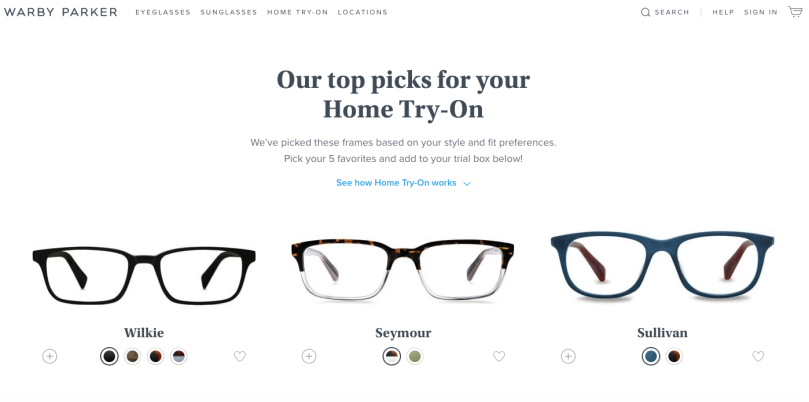
Warby Parker is a glasses frame manufacturer that has positioned itself as a company that sells fashionable frames at reasonable prices. Their storytelling focuses on how they build their frames and on the customers that buy them. In fact, much of their content is user-generated, which helps emphasize that they are frames built for everyone. Their message gets across because they keep their brand storytelling simple and focused.
These are a few brand storytelling examples to keep in mind when crafting your brand story strategy. Successful brand storytelling will strengthen your company’s identity, thereby making it easier to evoke an emotional response from your audience and to build long-lasting connections with them. By implementing an effective brand storytelling strategy, you’ll be more likely to increase your company’s visibility, impact, and — eventually — profit.
Actionable Next Step
Create a specific, branded hashtag for your customer base. Encourage your users to tag your business in their posts for a chance to be featured in your monthly newsletter or social media spotlights.
Frequently Asked Questions About Brand Storytelling
What are the 4 elements of a brand story?
The four core elements of a great brand story are the status quo (the current reality), the conflict (the customer’s problem), the solution (your product or service), and the resolution (the improved future for the customer).
Why do companies need brand storytelling?
Companies need storytelling because consumers do not buy what you do; they buy why you do it. Stories build emotional trust, which drives customer loyalty far better than price discounts or feature lists.
How do I find my company’s brand story?
Start by looking at your origins. Why did you start the business? What specific frustration were you trying to solve? Speak with your oldest customers to understand what emotional value you bring to their lives, and build your narrative around those truths.
Can small B2B companies use brand storytelling?
Absolutely. In fact, B2B companies need storytelling even more because their sales cycles are longer. By humanizing your team, showcasing real client transformations, and highlighting your core values, you stand out in a sea of dry corporate websites.
Download our Free Storybranding Strategy Workbook here.

Stevens & Tate Marketing is a full-service advertising agency offering award-winning, on-strategy creative; integrated message development; and cost-effective media planning and execution. The team creates targeted solutions for brand consistency, converting leads to customers, and web design and development. To learn more about how Stevens & Tate can help Make Things HappenTM for your business, call (630) 627-5200.